


Australia PR after student visa 2026 options (Ultimate Guide)
Last updated: February 2026
By Emerson Migration Law (Brisbane) led by Director Aishwarya Somal
If you are on (or finishing) a Student visa and your real goal is Permanent Residency, you are not alone. The challenge in 2026 is that Australia’s post-study landscape has tightened in key areas, and “just staying longer” is no longer a strategy.
Australia’s permanent migration program remains stable at approximately 185,000 places per program year, with the majority allocated to skilled migration categories. This confirms that skilled and employer pathways remain the dominant routes to PR.
This guide walks you through the most realistic Australia PR after student visa 2026 options, what has changed, and how to choose the pathway that fits your life, your work, and your timing.
Important: This is general information, not legal advice. Visa options depend on your course, age, occupation, location, work history, English, and personal circumstances.
Table of contents
- 2026: What changed for graduates
- Australia PR options after a student visa in 2026 explained (with who each fits)
- A practical 90-day PR plan after a student visa (2026)
- Common mistakes we see graduates make (and how to avoid them)
- FAQ: Australia PR after student visa 2026 options
2026: What changed for graduates
1) Temporary Graduate (485) Age Reduced to 35
A major 2024 reform reduced the maximum eligible age to 35 for most Temporary Graduate streams.
Important exceptions apply:
• Research Master’s and PhD graduates can apply up to age 50.
• Hong Kong and British National (Overseas) passport holders also retain eligibility up to 50.
2) Skilled migration is still available, but more “evidence-based”
Skilled pathways still work brilliantly when you match the demand signals Australia is rewarding: skills assessments, strong English, relevant work experience, and state/regional alignment.
3) Employer-sponsored options evolved with the SID framework
Home Affairs confirms that on 7 December 2024, the Skills in Demand (SID) visa replaced the Temporary Skill Shortage (TSS) visa.
For graduates, that matters because employer pathways are one of the most reliable bridges to PR when handled strategically.
Best PR options after a student visa in 2026 explained (with who each fits)
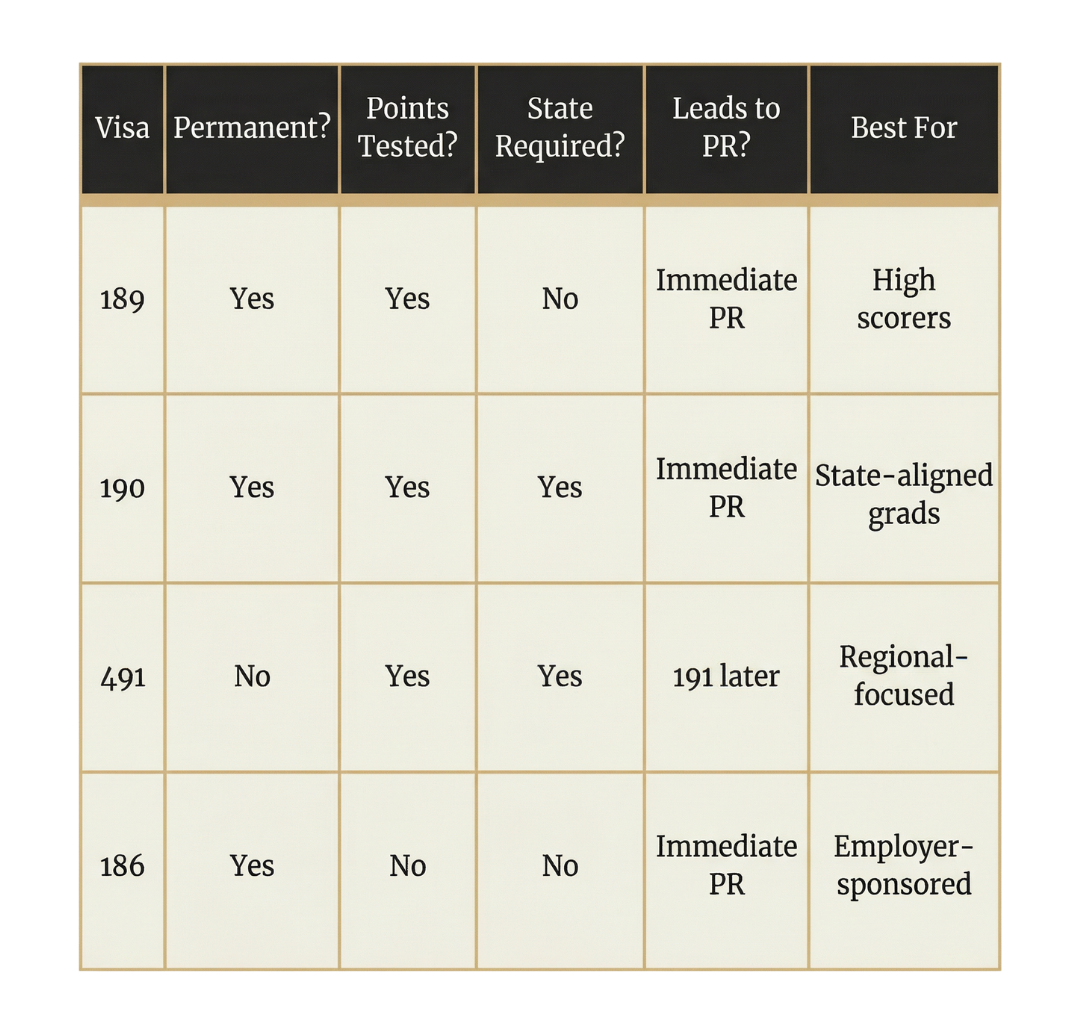
Option A: Skilled Independent PR (subclass 189)
Best for: high-scoring applicants in strong occupations who can compete without state nomination.
- You submit an Expression of Interest (EOI) through SkillSelect
- You need your occupation to be eligible, and you must meet the points requirements.
When 189 is realistic:
If you have strong English, a clean skills assessment outcome, and points that are genuinely competitive for your occupation.
Emerson internal reading:
If you want a plain English comparison of independent vs nominated PR routes, see our guide on the difference between 189 and 190: Skilled Independent vs Skilled Nominated.
Option B: Skilled Nominated PR (subclass 190)
Best for: applicants with a solid profile who can align with a state’s occupation needs.
- You still lodge an EOI via SkillSelect, but you seek State/Territory nomination
- Nomination allocations are controlled and change each program year, so timing and state strategy matter.
Why 190 is often the “smart PR” path:
It may be more achievable than 189 for many graduates because it uses state demand signals rather than pure national competition.
Emerson internal link:
Start with: General Skilled Migration (189/190/491).
Option C: Skilled Work Regional (Provisional) (subclass 491) → PR later
Best for: graduates who are open to regional Australia and want a more achievable nomination route.
Home Affairs describes the 491 as a visa for people nominated by a State/Territory government or sponsored by an eligible family member to live and work in regional Australia.
Why 491 is powerful in 2026:
If your metro points are not high enough for 189/190 invitations, regional nomination can be the pathway that keeps you in Australia legally while building your PR eligibility.
Option D: Employer sponsorship → PR via ENS 186 (where eligible)
Best for: graduates who can secure a genuine, skilled role with an employer willing to sponsor and plan long-term.
Your pathway here usually has two phases:
- Employer-sponsored temporary skilled visa (under the current framework)
- Transition to PR via ENS 186 (if you meet the stream requirements and your employer can support nomination)
Because processing times and program priorities can shift, the legal preparation quality matters. Home Affairs also publishes skilled visa processing priority guidance that influences how cases move through the system.
In many cases, time spent on a Skills in Demand (SID) visa can support eligibility for Employer Nomination Scheme (subclass 186) under the Temporary Residence Transition stream, provided salary, occupation, and employment requirements are met.
Graduates should structure their employment from day one with ENS eligibility in mind, not as an afterthought.
Emerson internal reading:
- ENS 186 processing time guide (2026 update)
- If you are considering employer pathways, we also recommend starting with a structured plan rather than “waiting and hoping.” Our Application Preparation Service explains what that looks like.
Option E: Temporary Graduate visa (subclass 485) as your “bridge visa with purpose”
Best for: graduates who need time to build eligibility for skilled nomination or employer sponsorship.
This is where many strategies succeed or fail. A 485 is not “extra time.” It is your project window.
Two crucial notes for 2026 planning:
- Legislative reforms reduced the maximum eligible age to 35 in key streams (with limited exceptions).
- English settings for 485 are governed by legislative instruments, and applicants should rely on these rather than social media summaries.
Option F: Partner visa (if genuinely applicable)
Best for: genuine couples who are ready to document their relationship properly.
This can be a very direct PR pathway, but it is evidence-heavy. If you are in this situation, get advice early, because timing, prior visa history, and documentation quality can make or break outcomes.
The “right” pathway depends on 6 reality checks (do these first)
Before you choose a visa plan, confirm:
- Your age, especially if you are relying on 485 eligibility (age tightening is real).
- Your occupation and whether it is on the relevant skilled lists for the visa you want (start from Home Affairs EOI guidance).
- Your skills assessment requirements (different assessing authorities, different evidence rules).
- Your English level (and whether you should aim beyond “minimum” for points competitiveness).
- Where you are willing to live (metro only vs open to regional).
- Whether you have a realistic employer sponsor (not just a friendly boss, but a business able to comply).
A practical 90-day PR plan after a student visa (2026)
If you want a plan that reduces panic and increases control, here is a strong starting structure:
Days 1 to 14
- Confirm your best pathway shortlist (189 vs 190 vs 491 vs employer).
- Map your occupation, assessing authority, and document list.
- Book a strategy consult if there is any complexity.
Days 15 to 45
- Prepare and lodge your skills assessment (or at least begin the evidence build).
- Sit English tests if you can improve points or meet a stricter threshold.
- Start state research if 190/491 is your likely pathway.
Days 46 to 90
- Prepare your EOI via SkillSelect, aligned to the pathway you are targeting.
- If employer route: ensure the position is correctly structured, compliant, and genuinely skilled.
- If regional: relocate strategically rather than emotionally.
Common mistakes we see graduates make (and how to avoid them)
- Planning off outdated TikTok rules instead of legislation and Home Affairs updates.
- Treating 485 as a holiday, then rushing skills assessment and points strategy when time is already tight.
- Choosing a state based on rumours, not nomination criteria and realistic occupation demand.
- Assuming an employer “can sponsor” without checking whether they can lawfully and practically do it.
Helpful official resources (authoritative outbound links)
These are the sources we recommend graduates rely on first:
- Home Affairs: SkillSelect
- Home Affairs: Expression of Interest (EOI) guidance
- Home Affairs: Regional visas overview (491 and related regional pathways)
- Home Affairs: State and territory nomination allocations
- Federal Register of Legislation: English language instrument for 485 (2025)
- Federal Register of Legislation: 485 reform explanatory material (age reduced to 35 in key streams)
Internal Emerson Migration Law guides (for deeper, practical guidance)
- General Skilled Migration (189/190/491)
- Difference between 189 and 190
- ENS 186 processing times (2026 update)
- Transparent consultation fees
- Application Preparation Service
- Emerson Migration Law homepage
FAQ: Australia PR after student visa 2026 options
– Can I get PR straight after a student visa?
Yes, it is possible to obtain Permanent Residency directly after a Student visa — but only if you already meet all the eligibility requirements for a PR visa at the time of application.
This means you must already have:
Speak to a Lawyer today
If you are interested in getting more information about a visa, get in touch with Emerson Migration Law for a consultation.
- A positive skills assessment in a relevant occupation
- Sufficient points (for points-tested visas like 189, 190 or 491)
- A valid Expression of Interest submitted via SkillSelect
- Or an employer ready to nominate you for a permanent visa such as subclass 186
Many graduates assume they must first apply for a Temporary Graduate visa (subclass 485). That is not legally required if you already qualify for PR. However, in practice, most graduates use the 485 as a structured bridging period to build competitiveness.
The key question is not “Can I apply?” but “Am I competitive enough to receive an invitation or nomination?”
If your points are borderline, your English is minimum level only, or your occupation demand is uncertain, applying prematurely may lead to long delays or no invitation at all.
– Is subclass 190 easier than 189?
In many cases, yes — but “easier” depends on your profile and the state nomination criteria at that time.
Subclass 189 (Skilled Independent) is purely points-tested at a national level. You compete against applicants across Australia and overseas in your occupation group. Invitations are issued based on ranking, and cut-off scores can be high in competitive occupations.
Subclass 190 (Skilled Nominated) requires nomination from a State or Territory government. When a state nominates you, you receive additional points, which improves your competitiveness.
However, state nomination is not automatic. Each state:
- Sets its own occupation lists
- Sets its own eligibility thresholds
- Has limited nomination allocations per program year
For many graduates, 190 becomes more realistic because it aligns with state labour demand rather than pure national ranking. But success depends on choosing the correct state strategy based on your occupation, employment situation, and residency location.
– Can I apply for PR while on a 485 visa?
Yes. Many graduates apply for PR while holding a Temporary Graduate visa (subclass 485).
In fact, this is one of the most common strategic pathways in 2026:
Student visa
→ 485 Temporary Graduate visa
→ Skilled or employer-sponsored PR
The 485 allows you to:
- Gain skilled work experience
- Improve your English test results
- Complete a skills assessment
- Align with state nomination requirements
- Secure employer sponsorship
However, the 485 should never be treated as “extra time.” It is a limited planning window. Age caps, occupation lists, and state nomination policies can change. Delaying preparation during your 485 period is one of the most common mistakes graduates make.
The strongest outcomes occur when PR planning begins immediately after graduation, not in the final year of the 485.
– Does regional study guarantee PR?
No. Studying in regional Australia does not guarantee Permanent Residency.
Regional study can provide:
- Additional migration points
- Access to regional nomination pathways such as subclass 491
- Potential priority in some state programs
But nomination is still competitive and subject to:
- Occupation demand
- State criteria
- Income thresholds
- Available allocations
Some graduates mistakenly believe that completing a course in a regional area automatically leads to PR. This is incorrect. Regional migration pathways still require skills assessments, English requirements, and in many cases, relevant employment.
Regional strategy works best when it is aligned with a long-term plan, not when chosen purely for migration points.
– What happens if I turn 35 before applying for a 485 visa?
In 2026, the maximum eligible age for most Temporary Graduate visa streams is 35 at the time of application.
If you turn 36 before lodging a valid 485 application, you may no longer be eligible unless you fall into an exception category.
Exceptions currently include:
- Research Masters graduates
- PhD graduates
- Certain Hong Kong or British National (Overseas) passport holders
Age eligibility is strictly assessed at the time the application is lodged. Even a one-day delay can affect eligibility.
Graduates approaching the age threshold should plan well in advance. Waiting until the final months of a Student visa without confirming eligibility can permanently remove this pathway.
– Can I switch employers on a Skills in Demand visa?
Yes, but the process must comply with sponsorship rules and nomination requirements.
The Skills in Demand framework replaced the former TSS visa. If you change employers, your new employer must:
- Be an approved sponsor
- Nominate you in an eligible occupation
- Meet salary and market rate requirements
You cannot simply “transfer” sponsorship informally. A new nomination process is typically required.
If your long-term goal is PR via subclass 186 under the Temporary Residence Transition stream, continuity of employment, occupation alignment, and salary compliance are critical. Changing employers without strategic planning can disrupt PR eligibility timelines.
Always assess the PR impact before changing sponsors.
– How long does PR take after studying in Australia?
Processing times vary significantly depending on the visa subclass, completeness of application, and program priorities.
Broadly:
Subclass 189 and 190 processing can range from several months to over a year, depending on occupation demand and invitation cycles.
Subclass 491 involves provisional residency first, with PR eligibility (subclass 191) after meeting income and residency requirements.
Employer-sponsored subclass 186 timelines depend on nomination readiness, employment duration, and processing volumes.
It is important to separate two timelines:
- Time to receive invitation or nomination
- Time for visa processing after lodgement
Many delays occur before an invitation is even issued, particularly if points are not competitive or state nomination is limited. The fastest pathway is not always the one with the shortest processing time — it is the one where you are most competitive.

Aishwarya Somal
LLB. (UQ) GradDipLP
Aishwarya Somal is a multi award-winning Australian Immigration lawyer, recognised for delivering commercially nuanced solutions for global investors, professionals, and businesses wishing to migrate to Australia. With a reputation for precision and personalised service, Aishwarya’s unique strength lies in navigating complex migration pathways with commercial insight and global perspective.

Leave a Reply