


DAMA Visas in Australia: Eligibility, How to Apply, and FAQs
If you have been researching regional employer-sponsored migration in Australia, you have probably come across the term DAMA and wondered
– whether DAMA is a real visa,
– whether you can apply for DAMA yourself, and
– whether DAMA offers a genuine pathway to permanent residency.
DAMA pathways are often discussed in a way that makes them sound simple. In reality, they are highly structured, region-specific, and employer-driven. They can open doors that standard sponsorship pathways do not. But they can also create false hope when people assume that a DAMA automatically means a visa grant or permanent residency.
This guide explains how DAMA visas in Australia work in 2026, who may be eligible, how the application process usually unfolds, and the most common issues we see people misunderstand.
For a broader view of employer-sponsored migration strategy, you can also read our dedicated page for Employer-Sponsored Visas.

What is a DAMA in Australia?
A Designated Area Migration Agreement, or DAMA, is not a visa subclass by itself. It is a structured labour agreement framework between the Australian Government and a state, territory, or regional authority known as a Designated Area Representative. Under that framework, eligible employers in the designated region may be able to access a wider range of occupations and negotiated concessions that are not usually available through standard skilled sponsorship pathways.
In practical terms, a DAMA usually operates in two layers.
– The first is the overarching regional agreement
– The second is the individual labour agreement that an endorsed employer seeks under that regional framework
Only after that process is in place can the business move to nomination and visa steps for an overseas worker. That is why people cannot simply “apply for a DAMA visa” on their own.
At the moment, Australia has 13 DAMAs in place, and the Department of Home Affairs confirms that these arrangements generally use the Skills in Demand (Subclass 482), Skilled Employer Sponsored Regional (Subclass 494), and Employer Nomination Scheme (Subclass 186) labour agreement pathways.
Who is a DAMA really for?
DAMA is usually most relevant for one of two groups.
- The first is the regional employer that has tried to recruit locally, still has a genuine labour shortage, and needs access to a broader occupation list or a concession on age, English, skills, or salary settings.
- The second is the worker who already has, or can secure, a genuine job offer from an eligible employer in a DAMA region and whose profile fits the specific occupation and concession settings for that region.
DAMA is usually not the right starting point for someone who only wants a list of occupations and hopes to apply independently from overseas. It is also not a shortcut around sponsorship compliance. If there is no real job, no qualifying employer, or no occupation match under the applicable regional agreement, the pathway usually ends there.
Current DAMA regions in Australia
The Department of Home Affairs confirms there are currently 13 DAMAs in place. These include regions such as:
– Adelaide City,
– Northern Territory,
– Orana,
– Far North Queensland,
– Great South Coast,
– Goulburn Valley,
– Townsville,
– and multiple Western Australian arrangements, including the broader WA DAMA.
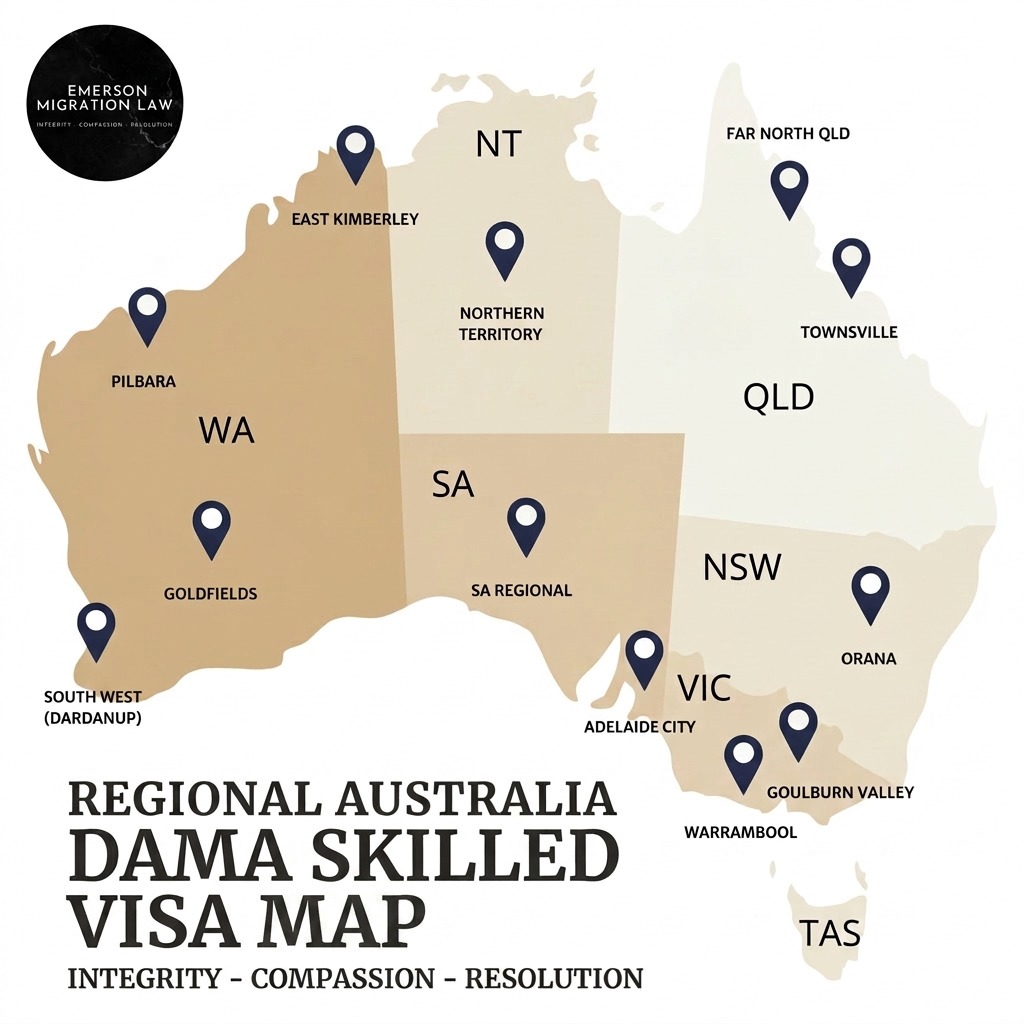
This matters because there is no single national DAMA occupation list. Each agreement has its own region, occupation coverage, and concession settings. South Australia, for example, publishes a dedicated DAMA occupation list for its agreements. Western Australia has a broader statewide DAMA structure in addition to regional WA arrangements. Orana and the Northern Territory also publish their own region-specific guidance for employers and prospective workers.
That is one of the biggest reasons online advice on DAMA becomes confusing. A statement that is true for one region may be wrong for another.
DAMA vs standard employer sponsorship
The reason DAMA attracts so much attention is that it may offer more flexibility than standard sponsorship.
Depending on the region and occupation, a DAMA may provide access to:
- a broader occupation list
- an age concession
- an English language concession
- a salary concession in some cases
- lower or alternative work experience requirements
- a more tailored pathway to permanent residency in the labour agreement context
That said, flexibility should never be mistaken for automatic eligibility. Each concession is conditional. Some regions limit concessions by occupation skill level, by visa subclass, by client-facing duties, by licensing requirements, or by whether the role is metropolitan or regional within that state. Western Australia’s current DAMA guidance is a good example of how detailed these distinctions can be.
Eligibility for a DAMA visa in Australia
1. Worker eligibility
For a worker, the starting point is usually this: you need a real employer sponsor first.
Across official and quasi-official DAMA guidance, the same fundamentals appear again and again. The worker usually needs:
- a genuine job offer from an endorsed employer in the designated area
- an occupation that appears on the relevant DAMA occupation list
- the qualifications, experience, and skill level required for that occupation
- a skills assessment where the occupation or region requires one
- the English level required for the visa or the specific concessional standard
- health and character clearance
- compliance with any age or salary conditions that still apply after concessions are considered
A point many people miss is that skills assessment rules can still matter even under DAMA. VETASSESS, for example, states that applicants should first have a form of employer offer or sponsorship before applying through the DAMA program and sets out how recent and relevant employment is assessed.
2. Employer eligibility
For the employer, the threshold question is not whether there is a vacancy. It is whether the business can satisfy the relevant region that it has a genuine, compliant labour need and should be endorsed to access the DAMA in the first place.
Official regional guidance consistently requires employers to show matters such as:
- lawful and active operation in the designated area
- evidence of local recruitment efforts
- financial capacity and business viability
- a genuine position in an occupation covered by the DAMA
- a satisfactory compliance history
- willingness to meet sponsorship and employment obligations under the relevant framework
In the Northern Territory, for example, the published guidance says businesses must have well-established operations in the NT for at least 12 months before sponsoring under the NT DAMA. In WA, the published criteria run in significant detail through registration, operating evidence, premises, financial material, and role justification.
Common DAMA concessions in 2026
This is where search interest is highest, and also where many articles become far too vague.
Age concessions
Some DAMAs can lift the standard permanent visa age ceiling, in certain occupations and on certain pathways. Western Australia, for example, expressly states that its current DAMA can increase the visa applicant age limit from 45 to 55. That does not mean every region or every occupation will do the same.
English concessions
English concessions can exist, but they are not universal and they are often narrower than people think. Western Australia’s published guidance, for instance, distinguishes between occupation skill levels and visa pathways, and notes that concessions may not be approved for client-facing roles, safety-sensitive roles, or where registration and licensing require a higher English standard.
Salary concessions
Some DAMAs can reduce the standard income threshold, but only within the settings negotiated for that agreement and occupation. Salary still needs to satisfy broader nomination and market-rate principles. The Department of Home Affairs states that the Temporary Skilled Migration Income Threshold is AUD 76,515 for nomination applications lodged between 1 July 2025 and 30 June 2026, and Fair Work rules continue to matter for lawful pay.
Speak to a Lawyer today
If you are interested in getting more information about a visa, get in touch with Emerson Migration Law for a consultation.
Work experience concessions
Some DAMAs may recognise lower work experience thresholds than standard settings. Western Australia’s current published DAMA guidance, for example, sets different experience expectations depending on the visa pathway and whether the role is in metropolitan Perth or regional WA.
The safest way to think about concessions is this: they are negotiated exceptions, not guaranteed entitlements.
How to apply for a DAMA visa in Australia
Although the detail varies by region, the broad process usually looks like this.
Step 1: Confirm the region and occupation
First, identify the right region and confirm that the occupation appears on the relevant DAMA list for the intended location and visa pathway. South Australia, WA, Orana, the NT, and Townsville all direct employers to region-specific occupation or access material.
Step 2: Employer seeks endorsement from the Designated Area Representative
Before the business approaches the Department of Home Affairs for a labour agreement, it must usually obtain endorsement from the region’s authorised Designated Area Representative. This is a foundational step and one that many generic DAMA articles mention only briefly, even though it is often where weak cases fail.
Step 3: Employer requests a labour agreement from the Department of Home Affairs
Once endorsed, the employer lodges the labour agreement request through the proper channel. The Department of Home Affairs expressly states that employers must obtain endorsement before lodging the labour agreement request through ImmiAccount.
Step 4: Nomination and visa application
If the labour agreement is approved, the employer can move to nomination for the identified worker, and the worker can then lodge the relevant visa application under the labour agreement stream, commonly under subclass 482, 494, or 186, depending on the arrangement and stage.
Step 5: Ongoing compliance
This is not merely an application exercise. The arrangement creates continuing compliance obligations for the employer and the worker. That is one reason strategic legal preparation matters. If your situation involves business structuring or sponsor risk, our articles on 482 visa self-sponsorship issues and immigration compliance risks for foreign investors may also be relevant.
Can DAMA lead to permanent residency?
In many cases, yes, potentially. But not automatically.
The Department of Home Affairs confirms that DAMAs can operate through the labour agreement streams of Subclass 482, Subclass 494 and Subclass 186.
The Northern Territory guidance also makes clear that permanent residency is not guaranteed, and that the permanent pathway depends on meeting the eligibility requirements under the relevant arrangement, with employer participation still essential.
That means the right question is not, “Does DAMA give PR?” The better question is, “Does this employer, occupation, region and visa pathway create a realistic route to 186 or another permanent outcome, and on what timeline?”
For some people, the strategy may involve 482 first and then a later 186 labour agreement pathway. For others, a 494 regional pathway may be the more coherent route. If permanent residency planning is central to your decision-making, you should not treat DAMA as a one-size-fits-all answer. You need the sequence mapped carefully from the outset. Our 186 Direct Entry guide is a useful companion piece for that analysis.
Mistakes people commonly make with DAMA
The first is assuming a DAMA is something the worker can lodge independently. It is not. The published NT guidance could not be clearer on this point.
The second is assuming all DAMA regions offer the same concessions. They do not. WA alone shows how much conditions can vary by geography, occupation level, and intended visa.
The third is treating occupation availability as enough on its own. In reality, the occupation, employer eligibility, regional coverage, salary settings, recruitment evidence, English settings, and longer-term visa strategy all need to line up together. This is especially important where the worker’s real goal is permanent residency rather than a temporary regional placement.
DAMA FAQs
Is a DAMA a visa?
No. A DAMA is a labour agreement framework that can support visa applications under the labour agreement streams of subclass 482, 494, and 186.
Can I apply for a DAMA visa without an employer?
No. The pathway is employer-driven. You need an eligible employer in a participating region.
Is DAMA only for regional Australia?
Mostly, yes, although the framework is region-specific and some arrangements are broader or more tailored than others. The newer WA DAMA, for example, includes both metropolitan Perth and regional WA categories.
Are DAMA occupation lists the same everywhere?
No. Each DAMA has its own occupation list and concession profile.
Does a DAMA always have lower English requirements?
No. Some do, some do not, and some only do for particular occupations or visa pathways. Licensing and public-facing work can also affect this.
Can a DAMA lead to PR after age 45?
Sometimes, yes. Certain DAMAs include age concessions, but that depends on the region, occupation and pathway. It should never be assumed without checking the current agreement settings.
How many DAMAs are active in Australia now?
The Department of Home Affairs states that there are currently 13 DAMAs in place.
What is the first practical step if I think I may be eligible?
For workers, it is usually securing or assessing a genuine employer opportunity in the correct region. For employers, it is checking regional eligibility and occupation coverage before preparing an endorsement strategy.
Final thoughts
DAMA can be an excellent pathway for the right employer and the right worker. However, the strongest DAMA cases are the ones where the legal strategy starts early and the long-term visa plan is considered from day one, not after a temporary grant has already been secured.
If you would like tailored advice on whether a DAMA pathway makes sense for your circumstances, or how it compares with other employer-sponsored options, you can explore our Employer-Sponsored Migration services or speak with our team at Emerson Migration Law.

Aishwarya Somal
LLB. (UQ) GradDipLP
Aishwarya Somal is a multi award-winning Australian Immigration lawyer, recognised for delivering commercially nuanced solutions for global investors, professionals, and businesses wishing to migrate to Australia. With a reputation for precision and personalised service, Aishwarya’s unique strength lies in navigating complex migration pathways with commercial insight and global perspective.

Leave a Reply