



Temporary 482 vs Permanent 186 Work Visas: Key Differences in 2026
For many skilled workers and Australian employers, the choice between a Subclass 482 visa and a Subclass 186 visa is not just a migration question. It is a life question.
One pathway may help you enter Australia sooner. The other may give you permanent residence and long-term security from the start. Both can be powerful options, but they serve different purposes, carry different obligations and require careful planning before an application is lodged.
This guide explains the key differences in clear terms between a Subclass 482 visa and a Subclass 186 visa, so you can understand which pathway may better suit your circumstances.
If you are an employer considering sponsorship, you may also wish to read our guide to Employer-Sponsored Visas in Australia. If you are already considering permanent residence, our detailed guide to the 186 Visa Direct Entry Stream may also be helpful.
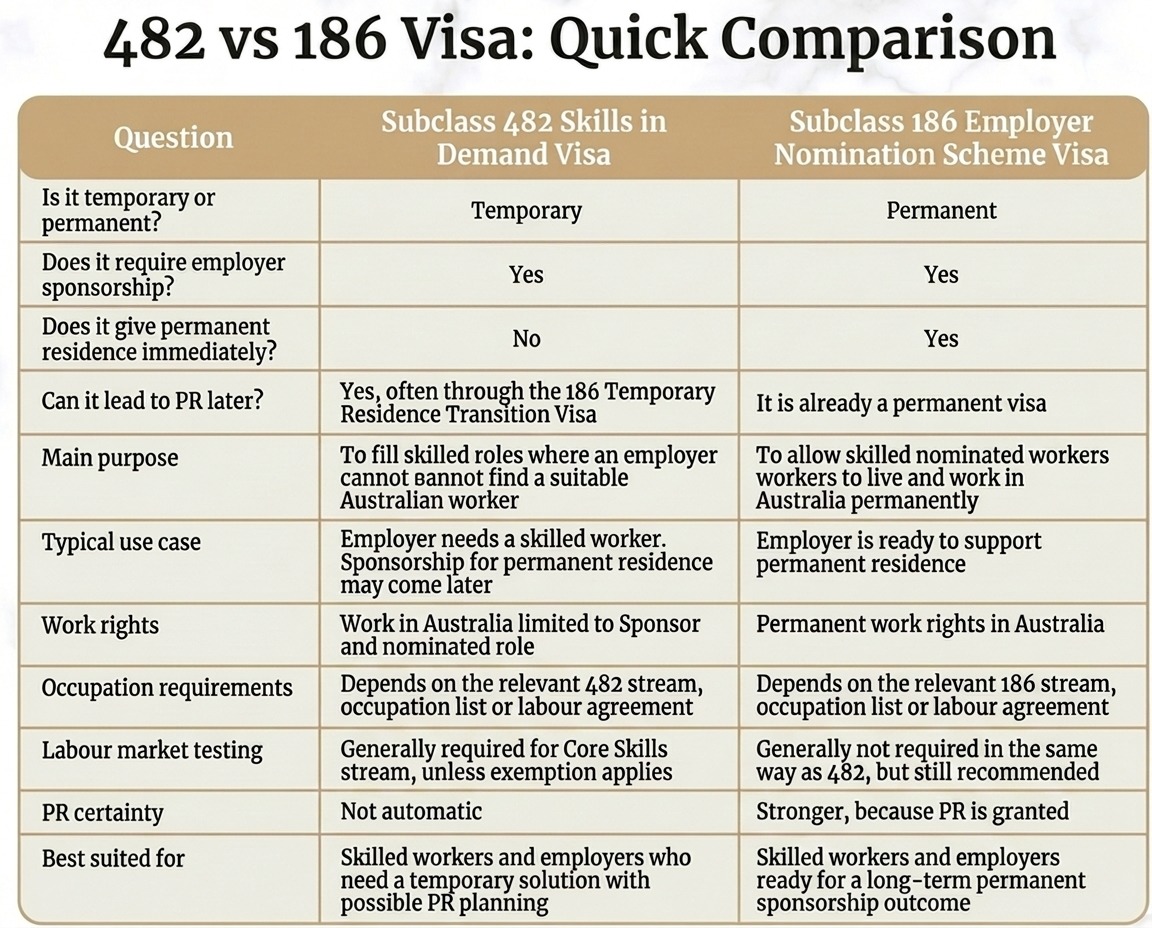
Table of Contents
- What Is the Subclass 482 Skills in Demand Visa?
- What Is the Subclass 186 Employer Nomination Scheme Visa?
- The Main Difference: Temporary Stay vs Permanent Residence
- 482 to 186 Pathway: Can a Subclass 482 Visa Lead to Permanent Residence?
- Eligibility Differences Between Subclass 482 and Subclass 186 Visas
- Salary Thresholds: A Critical Difference for Employers
- Labour Market Testing: Subclass 482 vs Subclass 186
- Skills Assessment: Which Visa Requires It?
- Employer Commitment: The Quiet Difference Many Applicants Miss
- Which Visa Is Better: Subclass 482 or Subclass 186?
- Common Mistakes When Comparing Subclass 482 and Subclass 186 Visas
- For Employers: When Should You Use a Subclass 482 vs Subclass 186 Visa?
- For Applicants: How to Decide Which Pathway Fits You
- Subclass 482 vs Subclass 186: Practical Examples
- Final Thoughts: The Right Visa Is the One That Fits the Strategy
- Frequently Asked Questions
What Is the Subclass 482 Skills in Demand Visa?
The Skills in Demand (Subclass 482) visa is a temporary employer-sponsored work visa. It allows an approved Australian employer to sponsor a skilled overseas worker for a role they cannot appropriately fill from the Australian labour market.
This visa replaced the previous Temporary Skill Shortage framework in December 2024, although the subclass number remained 482. The newer Skills in Demand framework reduced the general work experience requirement to one year in the nominated occupation or a related field, according to the Department of Home Affairs skilled visa changes announced in December 2024.
In practical terms, the Subclass 482 visa is often the first step for skilled workers who have an Australian job offer but are not yet ready, eligible or strategically positioned for permanent residence.
The Subclass 482 may be appropriate where:
- the employer needs the worker to start in Australia sooner
- the worker does not yet meet Subclass 186 requirements
- the employer wants to sponsor the worker first on a temporary basis
- the role falls under a suitable Subclass 482 stream
- the long-term plan may include a later transition to permanent residence
The Subclass 482 visa has different streams, including the Core Skills stream, Specialist Skills stream and Labour Agreement stream. The Core Skills stream is linked to the Core Skills Occupation List, while the Labour Agreement stream may apply where an employer has access to an approved labour agreement.
For employers in specific industries or regional areas, a labour agreement pathway may sometimes open options that are not available through the standard employer-sponsored visa program.
You can read more about Labour Agreements in our guide to DAMA Visas in Australia and our Aged Care Industry Labour Agreement guide.
What Is the Subclass 186 Employer Nomination Scheme Visa?
The Employer Nomination Scheme (Subclass 186) visa is a permanent residence visa. It allows a skilled worker nominated by an Australian employer to live and work in Australia permanently.
For many applicants, this is the preferred outcome because it offers greater security, a clearer long-term future, and the ability to settle in Australia with more confidence. The Department of Home Affairs states that the Subclass 186 visa lets skilled workers nominated by their employer live and work in Australia permanently.
The 186 visa has three main streams:
- Direct Entry stream
This is often used where the applicant is applying directly for permanent residence and can meet the required skills, English, age, occupation and experience requirements. - Temporary Residence Transition stream
This is commonly used by eligible temporary skilled visa holders who have worked for their sponsoring employer and are moving from temporary sponsorship to permanent residence. - Labour Agreement stream
This applies where the employer is party to a labour agreement that permits a permanent residence pathway.
The Direct Entry stream and Temporary Residence Transition stream generally requires the applicant to be under 45 at the time of application unless an exemption applies, and the nominated occupation must be eligible under the relevant framework.
For a deeper explanation of this pathway, see our guide to the 186 Visa Direct Entry Stream. If timing is one of your main concerns, our guide to ENS 186 Visa Processing Time may also assist.
The Main Difference: Temporary Stay vs Permanent Residence
The most important difference between a Subclass 482 visa and a Subclass 186 visa is simple:
A Subclass 482 visa is temporary.
A Subclass 186 visa is permanent.
That difference affects almost everything else, including your long-term security, employer obligations, planning timeline and future migration options.
A Subclass 482 visa allows you to live and work in Australia temporarily with the sponsoring employer while employed in the nominated position. It may give you a pathway to permanent residence later, but that is not automatic.
A Subclass 186 visa, by contrast, grants permanent residence if approved. It gives the applicant the ability to remain in Australia permanently, subject to the usual conditions that apply to permanent residents, including travel facility rules.
For applicants, this distinction is deeply personal. A temporary visa may feel like an opportunity, but it can also feel uncertain. A permanent visa may provide stability, but it usually requires a stronger application, greater employer commitment and a more carefully prepared nomination.
482 to 186 Pathway: Can a Subclass 482 Visa Lead to Permanent Residence?
Yes, a Subclass 482 visa can often lead to a Subclass 186 visa, but it does not happen automatically.
One of the most common pathways from the Subclass 482 to Subclass 186 is through the Temporary Residence Transition stream. This stream is designed for skilled workers who have already worked for their sponsoring employer in Australia and are then nominated for permanent residence.
Following the skilled visa changes introduced from December 2024, the Department of Home Affairs confirmed a smoother pathway to permanent residence for temporary skilled sponsored workers, including changes affecting the Temporary Residence Transition stream.
This means the Subclass 482 can be a strategic stepping stone. However, it should be planned from the beginning.
Before accepting a Subclass 482 sponsorship, workers should ask:
- Is the employer genuinely open to supporting permanent residence later?
- Is the occupation likely to support a future Subclass 186 nomination?
- Will the salary meet current and future threshold requirements?
- Is the role genuinely full-time and ongoing?
- Will the employer maintain compliance with sponsorship obligations?
- Are there age, English, skills, licensing or registration issues that could affect PR later?
A Subclass 482 visa can be a strong start. But if permanent residence is your goal, the migration strategy should not begin two years later. It should begin before the first nomination is lodged.
Eligibility Differences Between Subclass 482 and Subclass 186 Visas
Although both visas require employer nomination, the eligibility tests are different.
Subclass 482 Visa Eligibility
For the Skills in Demand (Subclass 482) visa, the worker generally needs:
- an approved Australian employer sponsor
- a nominated position
- relevant skills and experience
- an eligible occupation or labour agreement pathway
- English language ability, unless an exemption applies
- health and character clearance
- salary that meets the relevant income threshold and market salary requirements
The Department of Home Affairs states that primary Subclass 482 applicants must demonstrate English language proficiency unless an exemption applies.
Employers also need to consider salary and labour market requirements. Current salary rules require nominated workers under relevant employer-sponsored visas to be paid at least the applicable income threshold and the annual market salary rate. The Department of Home Affairs salary requirements page applies to nominations for Subclasses 482, 494, 186 and 187.
Subclass 186 Visa Eligibility
For the Employer Nomination Scheme (Subclass 186) visa, the worker generally needs:
- an Australian employer willing to nominate them
- a genuine position
- eligibility under one of the 186 streams
- skills and qualifications required for the nominated occupation
- English language ability, unless exempt
- health and character clearance
- compliance with age requirements, unless exempt
- salary and employment terms that meet the required legal standards
The Subclass 186 Direct Entry stream usually requires the applicant to be under 45 unless an exemption applies. It generally also requires a suitable skills assessment.
The practical difference is that the Subclass 186 visa is more “final”. Because it grants permanent residence, the application is usually scrutinised with a long-term lens. The employer must be ready to support an ongoing role, and the applicant must be able to satisfy the permanent visa criteria.
Salary Thresholds: A Critical Difference for Employers
Salary is one of the most common areas where employer-sponsored visa applications become risky.
For Subclass 482 and Subclass 186 nominations, the salary must generally satisfy two separate concepts:
- the relevant income threshold
- the annual market salary rate for the role
This means an employer cannot simply offer the minimum threshold if Australian workers in comparable roles are paid more. The salary must be defensible, properly documented and aligned with the nominated position.
For the 2025 to 2026 program year, the Core Skills Income Threshold is AUD 76,515 and the Specialist Skills Income Threshold is AUD 141,210. There are discussions of the Core Skills Income Threshold increasing to AUD 79,499 and the Specialist Skills Income Threshold increasing to AUD 146,717 for relevant new nominations from 1 July 2026.
This is especially important for employers planning sponsorship close to the end of the financial year. A nomination lodged before or after 1 July may be assessed against different salary thresholds.
For market salary benchmarking, employers may also need to consider independent sources such as the Fair Work Ombudsman pay and conditions resources and relevant industry salary evidence. The goal is not simply to meet a number. The goal is to show that the role, salary, duties, and business need all align.
Labour Market Testing: Subclass 482 vs Subclass 186
Labour market testing is another major difference.
For the Subclass 482 Core Skills stream, labour market testing is generally required unless an exemption applies. The Department of Home Affairs states that employers must now conduct two valid advertisements instead of three for relevant nominations.
For the Subclass 186 visa, labour market testing does not usually operate in the same way. This can make the 186 pathway attractive for employers who are ready to support permanent residence, but it does not mean the application is easy. The employer still needs to demonstrate that the nominated position is genuine and that the nominee meets the criteria.
In practice, both visas require careful evidence. The Subclass 482 focuses heavily on the temporary skilled need and labour market testing. The Subclass 186 focuses heavily on the permanent role, the applicant’s eligibility and whether the position genuinely supports permanent residence.
Skills Assessment: Which Visa Requires It?
A skills assessment may be required for some Subclass 482 applicants and is commonly required for many Subclass 186 Direct Entry applicants.
The Department of Home Affairs explains that a suitable skills assessment is mandatory for some visa subclasses and streams and may be requested for others.
For a Subclass 482 visa, the skills assessment requirement depends on the nominated occupation, stream, passport country and applicable rules.
For a Subclass 186 Direct Entry application, a skills assessment is often a central requirement unless an exemption applies. This is one reason the 186 Direct Entry pathway can require more preparation upfront.
Applicants should not assume that their degree, work history or licensing automatically satisfies the migration skills requirement. Each occupation may have its own assessing authority, evidence standard and documentation expectations. The Australian and New Zealand Standard Classification of Occupations can also be relevant when analysing whether the duties of a role align with the correct occupation.
Employer Commitment: The Quiet Difference Many Applicants Miss
On paper, both visas involve an employer.
In reality, the level of employer commitment can feel very different.
Speak to a Lawyer today
If you are interested in getting more information about a visa, get in touch with Emerson Migration Law for a consultation.
A Subclass 482 nomination is a temporary sponsorship commitment. It allows the employer to fill a skilled role for a defined period, subject to sponsorship obligations.
A Subclass 186 nomination is a permanent residence commitment. The employer is supporting the worker’s permanent migration outcome. That usually requires greater confidence in the worker, the business need, and the long-term role.
For applicants, this matters.
Some workers accept a Subclass 482 role believing permanent residence will naturally follow. But unless the employer is aligned with that plan, the worker may later discover that the business is unwilling, unable, or not yet eligible to support a Subclass 186 nomination.
Before relying on a Subclass 482 to Subclass 186 pathway, it is worth having a clear and respectful conversation with the employer about long-term sponsorship.
Important questions include:
- Would the employer consider nominating you for a Subclass 186 visa in the future?
- Is the position expected to remain available long term?
- Does the business understand the costs and compliance obligations?
- Is the salary likely to remain compliant after indexation?
- Does the business have a history of sponsoring workers successfully?
These conversations can feel delicate, especially when your visa status depends on your employment. However, clarity early often prevents stress later.
Which Visa Is Better: Subclass 482 or Subclass 186?
There is no universal answer. The better visa depends on your circumstances, your employer, your occupation, your timeline, and your long-term goals.
A Subclass 482 visa may be better if:
- you need a faster temporary sponsored work option
- your employer is not ready to support permanent residence yet
- you do not yet meet the Subclass 186 requirements
- you need Australian work experience before applying for PR
- your occupation fits the Subclass 482 framework
- you are building a pathway toward Subclass 186 later
A Subclass 186 visa may be better if:
- your employer is ready to nominate you for permanent residence
- you meet the age, skills, English, and occupation requirements
- your role is genuinely ongoing
- you want long-term stability in Australia
- you are eligible for Direct Entry, TRT, or a Labour Agreement pathway
- you want permanent residence without holding a temporary sponsored visa first
In many cases, the strongest strategy is not “482 or 186.”
It is “482 now, with a properly planned 186 pathway later.”
But in other cases, particularly where the applicant already meets the Subclass 186 Direct Entry requirements and the employer is ready, applying directly for the Subclass 186 visa may be more appropriate.
Common Mistakes When Comparing Subclass 482 and Subclass 186 Visas
Mistake 1: Assuming the Subclass 482 Automatically Leads to PR
A Subclass 482 visa can support a future permanent residence pathway, but it does not guarantee one. The employer must still nominate you, the role must remain suitable, and you must meet the Subclass 186 requirements at the time of application.
Mistake 2: Choosing a Subclass 482 Without Checking the Future Subclass 186 Pathway
Some applicants focus only on getting to Australia quickly. That is understandable, but it can create long-term problems if the occupation, salary, employer or role structure does not support a future Subclass 186 application.
Mistake 3: Treating Salary as a Simple Minimum Number
Salary must be assessed carefully. It is not only about meeting the income threshold. The salary should also reflect the annual market salary rate and be consistent with the duties and seniority of the nominated position.
Mistake 4: Ignoring Age
Age can be critical for permanent residence. Some Subclass 186 streams and exemptions may assist certain applicants, but timing still matters. If you are approaching an age threshold, it is important to seek advice early.
Mistake 5: Using the Wrong Occupation Code
Occupation alignment is one of the most important parts of an employer-sponsored visa strategy. If the nominated occupation does not match the real duties of the role, the application can become vulnerable.
Mistake 6: Waiting Until the Subclass 482 Is Almost Expired
Permanent residence planning should not be left until the final months of a temporary visa. By then, there may be limited time to deal with skills assessments, English tests, salary issues, employer documentation or unexpected changes.
If you have already received a refusal or are worried about a previous application history, our guide on how long after a visa refusal you can reapply may be a useful starting point.
For Employers: When Should You Use a Subclass 482 vs Subclass 186 Visa?
For employers, the choice often depends on workforce planning.
A Subclass 482 visa may be more suitable where the business needs a skilled worker for an immediate or temporary need, or where the employer wants to assess the working relationship before committing to permanent nomination.
A Subclass 186 visa may be more suitable where the role is long term, the worker is highly valued, and the business is ready to support a permanent outcome.
Employers should consider:
- how urgent the role is
- whether the role is temporary or ongoing
- whether the salary meets current thresholds
- whether the business can evidence market salary
- whether labour market testing is required
- whether the worker may be eligible for permanent residence
- whether sponsorship obligations can be managed properly
For many businesses, the wrong visa strategy can create unnecessary cost, delay, and compliance risk. A well-planned sponsorship pathway can support both the business and the employee.
For Applicants: How to Decide Which Pathway Fits You
If you are the visa applicant, start with your long-term goal.
If your goal is simply to work in Australia for a defined period, the Subclass 482 may be enough.
If your goal is to build a life in Australia, bring your family, access long-term security, and move toward citizenship in the future, you should think about permanent residence from the beginning.
Ask yourself:
- Do I want temporary work or permanent residence?
- Do I already meet Subclass 186 requirements?
- Is my employer willing to support PR?
- Is my occupation suitable for Subclass 482, Subclass 186, or both?
- Do I need a skills assessment?
- Will I meet the English requirement?
- Is age a concern?
- Does my salary meet the current threshold and market rate?
- Is my employer’s business genuinely able to support the nomination?
These questions can feel overwhelming. But they are also the questions that protect you from choosing a pathway that looks convenient now but becomes difficult later.
Subclass 482 vs Subclass 186: practical examples
Example 1: The software engineer with a strong job offer
A software engineer receives an offer from an Australian technology company. The employer needs them to start soon and is willing to sponsor them, but the worker has not yet completed all permanent residence requirements.
A Subclass 482 visa may be the practical first step. However, if the worker wants PR, the employer and worker should plan early for whether a Subclass 186 pathway may become available later.
Example 2: The senior manager with strong experience
A senior manager has extensive experience, strong English and an employer prepared to offer a permanent role. If the occupation, salary, skills and age requirements are satisfied, the Subclass 186 Direct Entry stream may be worth considering.
Example 3: The aged care employer in a regional area
An aged care provider may struggle to fill roles locally and may need to consider a labour agreement pathway. In that case, the standard Subclass 482 and Subclass 186 comparison may not be enough. The employer may need advice on whether an industry labour agreement, DAMA or another pathway is suitable.
Final Thoughts: The Right Visa Is the One That Fits the Strategy
The Subclass 482 and Subclass 186 visas are closely connected, but they are not interchangeable.
The Subclass 482 visa can provide a valuable temporary pathway into Australia. For many skilled workers, it is the first step toward building a future here.
The Subclass 186 visa offers something more permanent. It can provide the stability and security that many workers and families are ultimately seeking.
The key is not to choose based only on speed or convenience. The key is to choose based on your full migration strategy.
At Emerson Migration Law, we help you assess the pathway carefully and prepare a strategy that is legally sound, practical, and aligned with your long-term goals. You can book a consultation with our immigration experts through the form below.
Frequently Asked Questions
What is the main difference between a Subclass 482 and Subclass 186 visa?
The main difference is that the Subclass 482 visa is temporary, while the Subclass 186 visa is permanent. The Skills in Demand (Subclass 482) visa allows an approved employer to sponsor a skilled worker temporarily. The Employer Nomination Scheme (Subclass 186) visa grants permanent residence if approved.
Can a Subclass 482 visa lead to a Subclass 186 visa?
Yes, a Subclass 482 visa can often lead to a Subclass 186 visa through the Temporary Residence Transition stream, provided the worker, employer, role, salary and other requirements are met. However, permanent residence is not automatic.
Is the Subclass 186 visa better than the Subclass 482 visa?
The Subclass 186 visa may be better if your goal is permanent residence and you already meet the requirements. The Subclass 482 visa may be better if you need a temporary sponsored work pathway first or if you are not yet eligible for the Subclass 186 visa.
Do both Subclass 482 and Subclass 186 visas require employer sponsorship?
Yes. Both visas require employer nomination. The Subclass 482 is for temporary skilled sponsorship, while the Subclass 186 is for permanent employer nomination.
Can I apply for a Subclass 186 visa without holding a Subclass 482 visa first?
Yes, some applicants can apply directly through the Subclass 186 Direct Entry stream if they meet the requirements. Others may use the Subclass 482 first and later transition to the Subclass 186 Temporary Residence Transition stream.
Does the Subclass 482 visa give permanent residence?
No. The Subclass 482 visa is temporary. It may support a future PR pathway, but it does not grant permanent residence by itself.
Is labour market testing required for a Subclass 186 visa?
Labour market testing is generally associated with the Subclass 482 visa, particularly the Core Skills stream. The Subclass 186 visa does not specifically require labour market testing in the same way, although the employer must still show the position is genuine and the nomination meets the legal criteria.
What is the Subclass 482 to Subclass 186 pathway?
The Subclass 482 to Subclass 186 pathway usually refers to moving from a temporary Skills in Demand visa to permanent residence through the Employer Nomination Scheme Temporary Residence Transition stream. This generally requires planning with the sponsoring employer.
What salary is required for Subclass 482 and Subclass 186 visas?
The salary must generally meet the applicable income threshold and the annual market salary rate. For 2025 to 2026, the Core Skills Income Threshold is AUD 76,515, with reported increases from 1 July 2026 to AUD 79,499 for relevant new nominations. Specialist Skills thresholds are higher.
Should I choose the Subclass 482 or Subclass 186 visa?
You should choose based on your eligibility, employer support, occupation, salary, age, English ability and long-term goals. If permanent residence is your priority, it is important to assess whether a direct Subclass 186 pathway is available or whether a Subclass 482 to Subclass 186 strategy is more realistic.

Aishwarya Somal
LLB. (UQ) GradDipLP
Aishwarya Somal is a multi award-winning Australian Immigration lawyer, recognised for delivering commercially nuanced solutions for global investors, professionals, and businesses wishing to migrate to Australia. With a reputation for precision and personalised service, Aishwarya’s unique strength lies in navigating complex migration pathways with commercial insight and global perspective.

Leave a Reply