


by Emerson Migration Law
Updated to February 2026
Disclaimer
This guide does not take into account your individual circumstances. You should not rely on this information as a substitute for obtaining tailored legal advice from a qualified professional.
Foreign investors rarely encounter immigration problems because they set out to do the wrong thing. Issues usually arise much later — after an investment has been made, a business is operating, and no one has paused to check whether the visa position, investment approvals, and day-to-day activities still align.
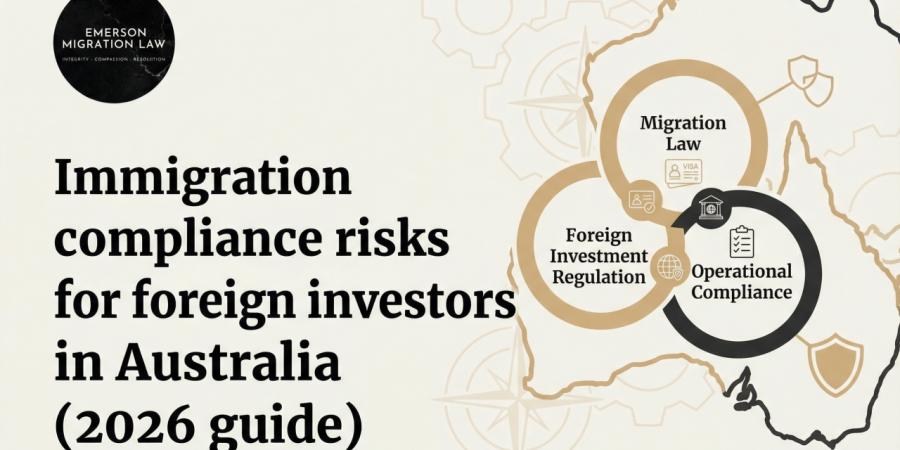
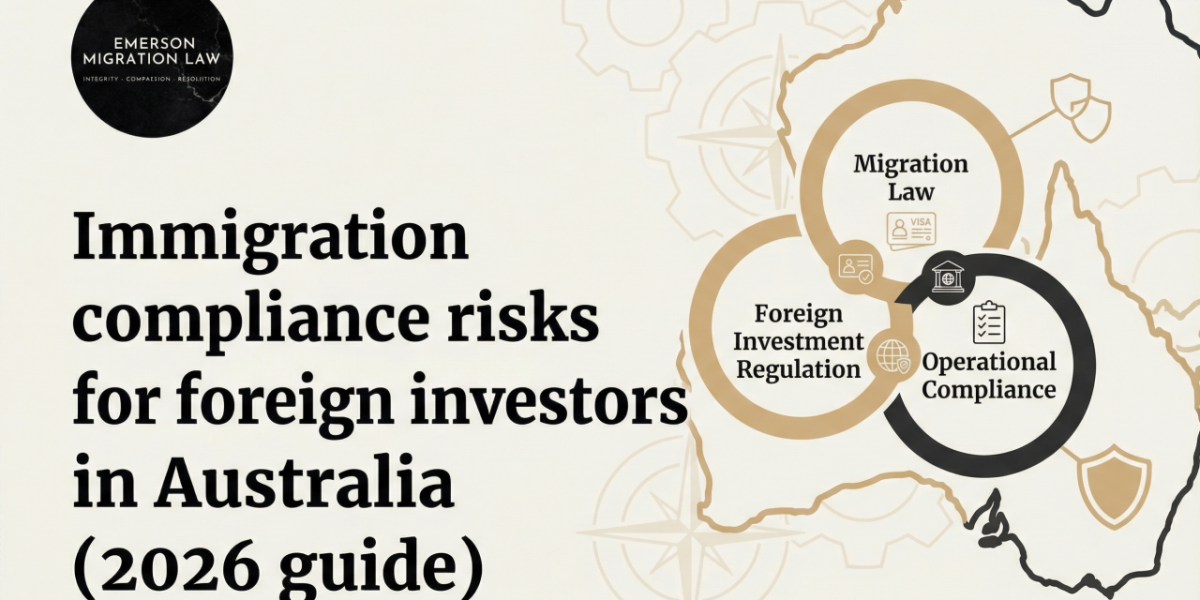
In Australia, immigration compliance for foreign investors is not a single obligation or formality. It sits at the intersection of migration law, foreign investment regulation, and how a business operates in practice. When those elements drift out of alignment, even unintentionally, the consequences can be serious.
The reassuring reality is that these risks are well understood. With the right structure and early advice, they are also highly manageable. This guide is designed to help foreign investors in Australia understand where compliance risks commonly arise, what has changed in the current regulatory environment, and how to protect both their migration position and their investment.
Table of contents
- What has changed for foreign investors in 2026
- What “immigration compliance risk” really means
- The 9 most common compliance risks (and how to prevent them)
- FIRB and ATO compliance essentials investors miss
- Visa pathways investors actually use now (without relying on outdated BIIP assumptions)
- A 30-minute compliance self-audit checklist
- FAQs
- How Emerson Migration Law can help
1) What has changed for foreign investors in 2026
Australia’s regulatory landscape for foreign investors has shifted significantly over the past two years. Some pathways that investors previously relied on are no longer available, while compliance expectations around reporting, record-keeping, and governance have become more structured and closely monitored.
Understanding what has changed — and, just as importantly, what assumptions are no longer safe — is critical before committing capital or reshaping an existing investment strategy.
BIIP is closed to new applications
The Business Innovation and Investment Program (BIIP) is closed to new applications (closure date 31 July 2024), with official information maintained by the Department of Home Affairs. If your strategy still assumes a BIIP stream will be available, that is now a high-risk planning error. See Home Affairs’ official BIIP closure page. BIIP closure and refunds (emersonmigrationlaw.com.au)
Foreign investment screening thresholds updated from 1 January 2026
Treasury indexes screening thresholds annually. For 2026, Treasury publishes the updated thresholds and the official downloadable table. You should always rely on Treasury’s current thresholds, not third-party summaries. Treasury monetary thresholds (Foreign investment in Australia)
Compliance reporting moved into the Foreign Investment Portal
Since 24 February 2025, Treasury’s position is that compliance reporting should be done through the Foreign Investment Portal. That has materially increased traceability and enforcement capability. Compliance reporting guidance (Foreign investment in Australia)
Enforcement expectations are explicit
Treasury’s compliance page makes it clear that non-compliance can lead to serious consequences and can be considered in future dealings with Government, and strongly encourages voluntary disclosure. Know your obligations (Foreign investment in Australia)
2) What “immigration compliance risk” really means for foreign investors
For foreign investors, immigration compliance risk rarely presents as a single obvious breach. It tends to emerge gradually, through ordinary business decisions that were never intended to cause a problem.
At Emerson Migration Law, we most often see compliance risk arise where:
- the investor’s visa conditions do not fully align with their operational involvement in the business
- ownership or control structures create uncertainty about who is actually directing the business
- foreign investment reporting or conditions are overlooked after approval
- employer sponsorship obligations introduce an additional layer of regulatory exposure
Individually, these issues may seem administrative or technical. Taken together, they can raise broader questions about credibility, governance, and compliance — particularly if an application, renewal, or audit occurs later.
This is why we approach immigration compliance as an ongoing system, rather than a one-off checklist.
3) The 9 most common immigration compliance risks (and how to prevent them)
Risk 1: Treating FIRB approval like permission to live and work in Australia
A common misconception among foreign investors is that approval under Australia’s foreign investment framework also confers immigration permission.
Foreign investment approval and visa status operate under separate legal regimes, with different decision-makers, criteria, and consequences. While they often interact in practice, one does not replace the other. Treasury expects investors to understand obligations. Foreign investment compliance obligations (Foreign investment in Australia)
Prevention: align visa strategy, transaction structure, and governance documents at the start, before you commit capital.
Risk 2: Missing a condition or reporting deadline after approval
Many investors focus on the approval and forget the conditions. Treasury’s compliance reporting guidance exists because conditions are actively monitored, and reporting is now centralized in the Portal. Compliance reporting rules (Foreign investment in Australia)
Prevention: build a compliance calendar the day you receive a no objection notification or exemption certificate.
Risk 3: Using outdated monetary thresholds
Thresholds change. If you are using a 2024 or 2025 blog post to assess a 2026 transaction, you are exposed.
Prevention: use Treasury’s 2026 thresholds table each time you assess a new acquisition. 2026 monetary thresholds (Foreign investment in Australia)
Risk 4: Not registering or updating assets with the ATO foreign investor system
Foreign investor obligations often include ATO registration and ongoing updates through ATO online services for foreign investors. ATO register or manage an asset
Prevention: treat registrations and updates as part of the transaction completion process, not an afterthought.
Risk 5: Residential property compliance traps
Residential property rules are actively enforced and can involve bans, exceptions, conditions, and reporting obligations depending on the asset and investor type. Even sophisticated investors make mistakes here because timelines feel urgent and the rules are technical.
Prevention: treat residential acquisitions as a regulated process, not a standard conveyance.
Speak to a Lawyer today
If you are interested in getting more information about a visa, get in touch with Emerson Migration Law for a consultation.
Risk 6: “I’m not working, I’m just helping” (the investor work rights trap)
This is one of the most common issues we see at Emerson Migration Law.
Operational involvement can look like work even when unpaid, especially if you are:
- directing staff day to day
- negotiating contracts in Australia
- representing the business publicly
- performing core duties that resemble employment
Prevention: document your role properly and design governance so decision-making is consistent with your visa position.
Risk 7: Self sponsorship and circular control exposure
Where investors explore employer sponsorship as a pathway, the risk is not sponsorship itself. The risk is an arrangement that appears to be “self sponsorship in substance” with insufficient separation, genuineness evidence, or governance independence.
If this is relevant, start with Emerson Migration Law’s guidance: Can business owners sponsor themselves for a 482 visa?
Risk 8: Sponsorship obligations breaches (once you sponsor, you are monitored)
Home Affairs is explicit that sponsor compliance is monitored during sponsorship and for years after it ends, and there are defined obligations for standard business sponsors. Standard business sponsor obligations (Immigration and citizenship Website)
Prevention: implement internal sponsorship governance early, even if you only sponsor one person.
Risk 9: Underestimating tax conditions and tax governance
Treasury can impose tax conditions as part of foreign investment approvals. Treasury’s guidance explains why tax conditions may be imposed and why compliance matters. Treasury tax conditions guidance
Prevention: ensure your tax governance capability matches your approvals. For a practical industry view on heightened enforcement behavior, see PwC’s discussion of compliance approach and detection letters. PwC foreign investor tax condition reporting update
4) FIRB and ATO compliance essentials investors miss
The Foreign Investment Portal is now part of the compliance story
Treasury guidance is clear: compliance reporting should be through the Portal. It also includes practical fact sheets and updated instructions. Foreign Investment Portal information (Foreign investment in Australia)
Record keeping is not optional
Treasury’s obligations guidance places responsibility on the investor and emphasizes record keeping, reporting, and disclosure expectations. Treasury investor obligations (Foreign investment in Australia)
Enforcement is increasingly data-driven
Government and professional commentary show increasing sophistication in detection, monitoring, and cross-agency integration. If your compliance posture is messy, it is no longer invisible. For an independent overview of enforcement and monitoring in residential foreign investment, see the ANAO audit report. ANAO report on compliance with foreign investment obligations (anao.gov.au)
5) What visa pathways do foreign investors actually use now?
Because BIIP is closed to new applications, the correct approach in 2026 is to choose a migration pathway that matches the individual’s profile and the reality of the business, rather than trying to force an “investor visa” narrative.
Common pathways that may be relevant depending on facts include:
- National Innovation Visa (Subclass 858) for eligible applicants with internationally recognised achievement. Australia’s National Innovation Visa (Subclass 858)
Emerson Migration Law guide: Australia’s National Innovation Visa (Subclass 858) - Employer-sponsored pathways where genuine, properly structured, and evidence- supported.
For sponsor obligations, use Home Affairs as the baseline. Sponsor obligations (Immigration and citizenship Website)
If you want a practical starting point from Emerson Migration Law, you can begin here: Business and investment visas and Services.
6) A 30-minute compliance self-audit checklist (investors love this)
This checklist is designed as a practical starting point. It is not about identifying fault, but about creating clarity.
If you can answer these questions confidently — and document the answers — you are usually well placed from a compliance perspective. Where answers are unclear, that uncertainty itself is often the signal to seek advice before issues arise.
A) Visa and work rights alignment
- What visa does each key person hold (you, co-founders, spouse, executives)?
- Are there any roles or work restrictions that your day-to-day conduct might challenge?
- Are you doing any operational tasks that could be interpreted as work?
B) Ownership, control, and governance clarity
- Is the corporate structure clear and properly documented?
- Do board minutes and resolutions reflect real decisions and real authority?
- Are director duties and decision rights consistent with the narrative you rely on?
C) Foreign investment approvals and conditions
- Do you have all approvals, conditions, and exemption certificates stored in one place?
- Have you mapped every reporting deadline and “trigger event” into a calendar?
- Are you reporting through the Portal as required? Compliance reporting guidance (Foreign investment in Australia)
D) Thresholds and future acquisitions
- Are you using Treasury’s current thresholds (2026) for any upcoming deal? Monetary thresholds (Foreign investment in Australia)
E) ATO foreign investor registrations
- Have you registered and updated relevant assets via ATO online services? Register or manage an asset
F) Tax conditions and tax governance
- Do you have any tax conditions attached to approvals? Tax conditions guidance
- If yes, do you have a documented governance process to comply consistently?
FAQs
Can non-compliance affect future approvals or dealings with the Government?
Yes. Treasury’s obligations page states non-compliance can be considered in future interactions with the Government and can lead to serious penalties. Treasury compliance obligations (Foreign investment in Australia)
Do I really need to worry if my investment is small?
Sometimes the highest risk is not size. It is asset type, investor type, sector sensitivity, and whether you fall into categories with lower thresholds or special rules. Always check Treasury’s current thresholds for your category. Monetary thresholds (Foreign investment in Australia)
What is the single biggest avoidable mistake?
Treating compliance as an event rather than a system. Approval is the beginning, not the end.
How Emerson Migration Law can help
At Emerson Migration Law, we don’t just aim for “visa approval.” We aim for structure, credibility and longevity, because investors deserve to feel safe in what they are building.
If you seek guidance tailored to your specific situation, please tell us more through the form below:

Aishwarya Somal
LLB. (UQ) GradDipLP
Aishwarya Somal is a multi award-winning Australian Immigration lawyer, recognised for delivering commercially nuanced solutions for global investors, professionals, and businesses wishing to migrate to Australia. With a reputation for precision and personalised service, Aishwarya’s unique strength lies in navigating complex migration pathways with commercial insight and global perspective.

Leave a Reply