



How Long After a Visa Refusal Can I Reapply?
Updated to January 2026 | by Emerson Migration Law
A visa refusal can be unsettling. For many people, it creates uncertainty about their future plans, their status in Australia, and what options remain available. One of the most common questions we hear when advising clients on Australian visa refusals is:
“How long after a visa refusal can I reapply?”
In many cases, you may be able to reapply straight away. There is no automatic waiting period that applies to every refusal. However, under Australian migration law, the correct answer depends on several legal factors that are not always obvious at first glance. This guide explains, in clear and practical terms, when reapplying is possible, when waiting is sensible, and when the law restricts further applications.
Table of Contents
- How Long After a Visa Refusal Can I Reapply?
- The Short Answer: When Reapplying Is Possible
- Step 1: Confirm What Decision You Actually Received
- Step 2: Onshore Limitations After a Visa Refusal (Section 48)
- Step 3: Non-Grant Periods and Public Interest Criterion 4020
- Step 4: “No Further Stay” Conditions
- Reapply or Seek Review?
- When Reapplying Makes Sense
- A Practical Reapplication Checklist
- Frequently Asked Questions
- A Final Word
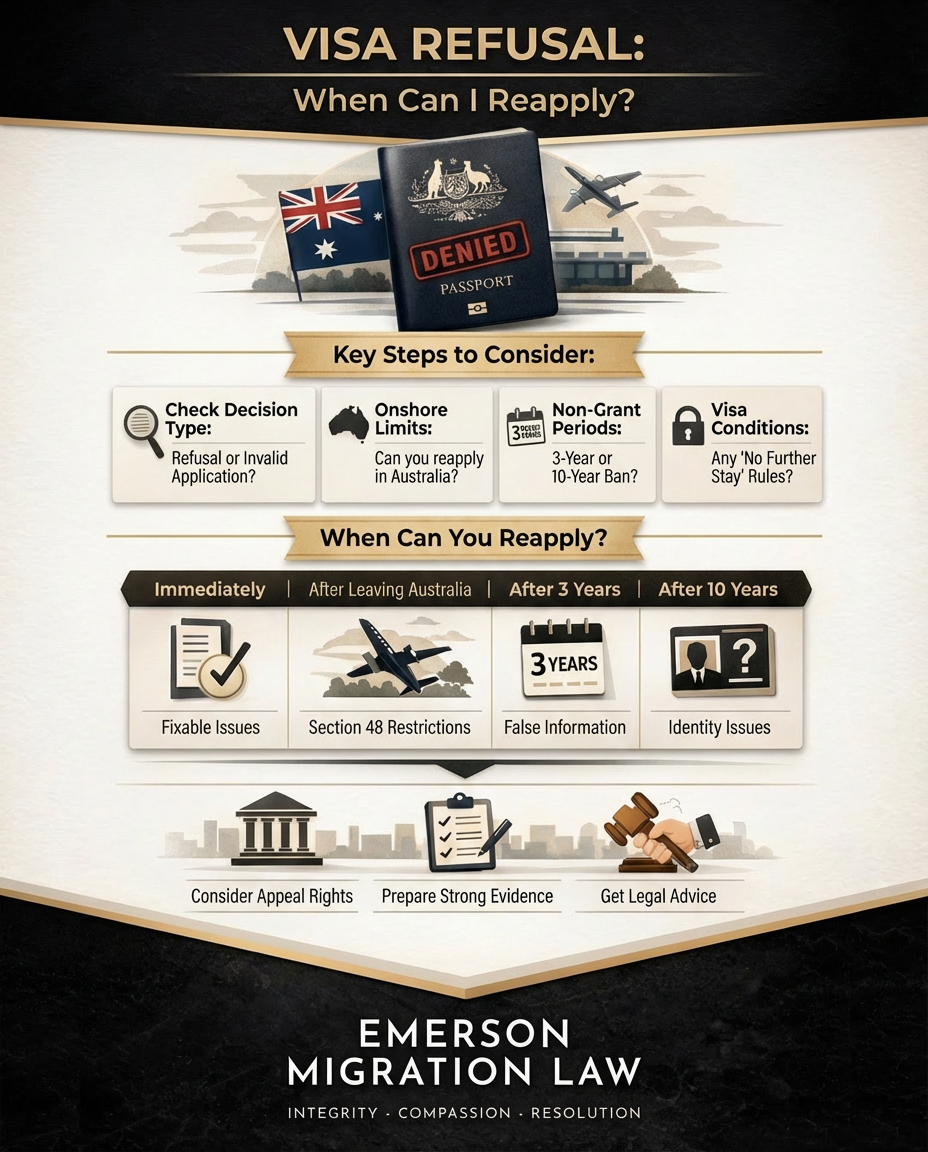
The short answer
In the event of an unexpected visa refusal, you may be able to reapply:
- Immediately, where the refusal was based on fixable evidence issues and no legal restriction applies
- Only after leaving Australia, where onshore application restrictions apply
- After three years, where a non-grant period applies due to false or misleading information
- After ten years, where a non-grant period applies because identity was not established
Understanding which category applies to you is essential before taking the next step.
Step 1: Confirm what decision you actually received
Before thinking about a new application, it is important to confirm whether your application was:
- refused or;
- found to be invalid.
A refusal is a decision made on a valid application. An invalid application is treated differently and may not trigger the same consequences, particularly for people who are in Australia. The Department of Home Affairs explains this distinction in its guidance on visa refusals and cancellations.
Your decision letter usually makes this clear. If there is any doubt, it is best to clarify this before proceeding, as the distinction can significantly affect your options.
Step 2: Onshore limitations after a refusal
A common misunderstanding is assuming that being able to reapply automatically means being able to reapply from within Australia.
If you are in Australia and do not hold a substantive visa at the time of refusal, Australian migration law may restrict the types of visas you can apply for while remaining onshore. These are commonly referred to as section 48 limitations, and they are outlined by the Department of Home Affairs in Form 1026i – Becoming unlawful and consequences.
In practical terms, this can mean:
- You are unable to apply for most substantive visas while in Australia
- You may need to leave Australia before lodging a new application
- Your onshore options may be limited
Where a refusal or cancellation involves character grounds, the restrictions can be even more serious, sometimes preventing further onshore applications altogether.
This is why, in many cases, the real question is not simply “Can I reapply?” but “Can I reapply from Australia, or do I need an offshore strategy?”
Step 3: Non-grant periods and Public Interest Criterion 4020
Some refusals carry mandatory non-grant periods, most commonly under Public Interest Criterion 4020.
This criterion relates to situations involving:
Speak to a Lawyer today
If you are interested in getting more information about a visa, get in touch with Emerson Migration Law for a consultation.
- Bogus documents
- Information that is false or misleading
- Identity not being established to the satisfaction of the Department
The Department of Home Affairs explains these consequences in its policy guidance on PIC 4020. Where this criterion applies:
- A three-year non-grant period may apply if the refusal involved false or misleading information or documents
- A ten-year non-grant period may apply if the refusal was based on identity concerns
This is not described in law as a blanket ban on all visas. Rather, it limits the grant of visas that contain this criterion for the relevant period.
These cases require careful handling. Reapplying too quickly, or without a clear legal strategy, can make future applications more difficult.
Step 4: “No further stay” conditions
Some visa holders are also subject to no further stay conditions, such as condition 8503.
The Department of Home Affairs explains these conditions and the limited circumstances in which a waiver may be available on its page about visa conditions and waivers.
Where these conditions apply, you may be prevented from applying for most visas while in Australia unless a waiver is granted. This can affect both the timing and location of any future application.
Reapply or seek review?
If your refusal carries review rights, preserving those rights is often the first priority. Review applications must usually be lodged within strict time limits set out in the decision letter.
The Administrative Review Tribunal sets these time limits, which are often short. Missing them can permanently close off review options.
In some cases, merits review may be the most appropriate pathway. In others, a carefully prepared fresh application is the better option. The right approach depends on the refusal grounds, your visa status, and your longer-term objectives.
When reapplying makes sense
Reapplying may be appropriate where:
- The refusal was based on missing or insufficient evidence
- Your financial, employment, or personal circumstances have since changed
- You can now directly address the concerns raised by the decision-maker
What matters most is not speed, but whether the new application genuinely resolves the issues that led to refusal.
A practical reapplication checklist
Before lodging a new application, you should be able to say with confidence that:
- You understand every reason given for the refusal
- You have confirmed whether onshore application limits apply to you
- You have identified any non-grant periods that may affect your case
- You have checked for visa conditions that restrict further applications
- Your new evidence is stronger, clearer, and consistent with your previous history
If any of these points are unclear, pausing to obtain migration law advice is usually the safer course.
Frequently asked questions
Can I reapply immediately after a visa refusal?
Often yes, provided no onshore restrictions, non-grant periods, or visa conditions prevent you from doing so.
How long do I have to wait after a refusal involving false information?
Where Public Interest Criterion 4020 applies, a three-year non-grant period may apply for visas that contain this criterion.
How long is the waiting period after an identity-related refusal?
Where identity could not be established and PIC 4020 applies, a ten-year non-grant period may apply.
If my visa was refused in Australia, can I apply again without leaving?
Not always. In many cases, you may need to leave Australia before lodging a new application.
A final word
A visa refusal is not just an administrative outcome. It is a legal decision that shapes what options are realistically available to you next.
Before reapplying, it is important to understand not only whether you can apply again, but how, when, and from where. Clear advice at this stage can prevent further refusals and protect your longer-term migration prospects.
If you would like assistance reviewing your refusal or planning your next steps, our team at Emerson Migration Law can help you assess your options with care and clarity.

Aishwarya Somal
LLB. (UQ) GradDipLP
Aishwarya Somal is a multi award-winning Australian Immigration lawyer, recognised for delivering commercially nuanced solutions for global investors, professionals, and businesses wishing to migrate to Australia. With a reputation for precision and personalised service, Aishwarya’s unique strength lies in navigating complex migration pathways with commercial insight and global perspective.

Leave a Reply